Navigating the complexities of mergers and acquisitions, venture capital investments, or strategic partnerships often hinges on a deep understanding of the target company’s technological landscape. This isn’t merely about admiring their innovative products; it’s about peeling back the layers to examine the underlying infrastructure, the development practices, and the people who build and maintain it all. Without a thorough technical assessment, potential risks can remain hidden, leading to costly surprises down the road that could jeopardize the entire endeavor.
The process of technical due diligence is a critical exercise that demands meticulous attention to detail and a holistic view of the technology ecosystem. It involves far more than just a cursory glance at code repositories or server logs. Instead, it’s a comprehensive investigation into the robustness of the architecture, the scalability of the systems, the security posture, the efficiency of the development team, and the overall technical debt. This deep dive ensures that stakeholders have a clear picture of what they are truly acquiring, investing in, or partnering with.
Given the intricate nature of this evaluation, having a structured approach is not just helpful, it’s essential. This is where a well-designed technical due diligence report template becomes an invaluable tool. It provides a systematic framework to guide the assessment, ensure all critical areas are covered, and present the findings in a clear, concise, and actionable manner, empowering informed decision-making for all parties involved.
What Makes a Robust Technical Due Diligence Report?
A truly effective technical due diligence report goes far beyond a simple checklist; it offers a narrative that explains the “what,” “how,” and “why” of a company’s technology. It paints a picture of its current state, its potential for future growth, and any inherent challenges that might impede its progress. The report should offer a balanced view, highlighting both the strengths and weaknesses, and providing strategic recommendations for risk mitigation and value enhancement. Understanding the technology isn’t just about the code; it’s about understanding its impact on the business operations, its customers, and its future trajectory.
One of the core components of any comprehensive report is the detailed analysis of the product and its underlying technology stack. This involves scrutinizing the architecture to determine its flexibility, scalability, and resilience. Questions about whether the system can handle increased load, integrate with other platforms, or adapt to new market demands are paramount. Furthermore, the report delves into the quality of the codebase, the reliance on third-party components, and the overall maintainability, all of which contribute to the long-term viability and operational costs of the product.
Beyond the product itself, the report must also thoroughly evaluate the “people” behind the technology. This includes assessing the technical team’s expertise, their organizational structure, and their capacity to innovate and maintain the systems effectively. Are there single points of failure within the team? Is the team adequately staffed and skilled for the current and projected workload? Understanding the team dynamics and their capabilities is crucial, as even the most brilliant technology can falter without the right talent to support and evolve it.
Equally important is an examination of the “process” aspects of technology development and operations. This covers everything from software development lifecycles, quality assurance protocols, deployment strategies, and incident response procedures. A mature and well-defined set of processes indicates a reliable and predictable technical operation, while a lack thereof can signal potential instability and future operational headaches. The report critically assesses these processes to gauge their effectiveness and adherence to industry best practices.
Finally, a robust technical due diligence report synthesizes these findings into actionable insights, providing a clear understanding of the risks and opportunities. It translates technical jargon into business language, allowing non-technical stakeholders to grasp the financial implications of technical debt, the costs associated with upgrading outdated systems, or the competitive advantages offered by innovative solutions. The report often concludes with recommendations for post-acquisition integration or investment strategies, ensuring the technical findings directly inform strategic business decisions.
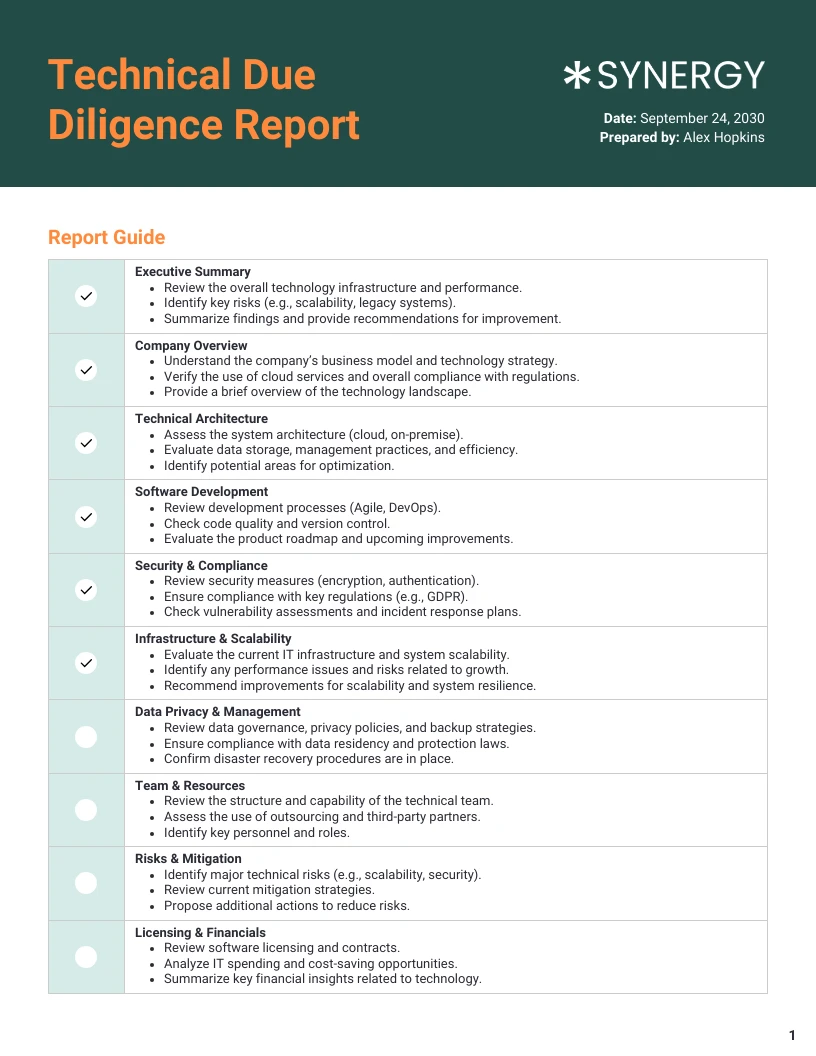
Key Sections of a Comprehensive Report
- Executive Summary
- Technology Stack Analysis
- Architecture and Scalability Review
- Security Assessment
- Development Process and Methodologies
- Team Structure and Capabilities
- Technical Debt and Maintainability
- Intellectual Property Review
- Operational Readiness and Infrastructure
- Key Risks and Mitigation Strategies
- Recommendations and Future Roadmap Considerations
Leveraging a Technical Due Diligence Report Template for Efficiency
The sheer volume of information to be gathered and analyzed during a technical due diligence exercise can be overwhelming. This is precisely where a well-crafted technical due diligence report template proves its worth, transforming a potentially chaotic process into a streamlined and highly efficient one. By providing a pre-defined structure, it ensures that no critical area is overlooked and that the findings are presented in a consistent and easy-to-understand format, which is invaluable when multiple parties need to review and digest complex technical information.
Using a template significantly reduces the time and effort required to compile the final report. Instead of starting from scratch, the diligence team can focus their energy on gathering data and performing in-depth analysis, rather than spending countless hours on formatting and structuring the document. This not only accelerates the reporting phase but also enhances the overall quality and comprehensiveness of the output, ensuring that all key aspects of the technical landscape are thoroughly addressed.
Furthermore, a standardized template promotes consistency across different technical due diligence projects, allowing for easier comparison and benchmarking. While each assessment is unique, the core components and areas of investigation often remain similar. A robust technical due diligence report template can be customized to fit the specific nuances of an industry or a particular target company, providing a flexible yet structured approach that adapts to varying needs without sacrificing thoroughness. It ensures that the essential questions are always asked and the critical information is always captured.
The journey through technical due diligence is a critical phase in any significant business transaction, laying bare the technological realities that underpin a company’s value. A meticulously prepared report, guided by a comprehensive framework, acts as an indispensable compass, steering stakeholders toward informed decisions and mitigating potential pitfalls. It transforms uncertainty into clarity, allowing for a strategic alignment of business objectives with technological capabilities.
Ultimately, the goal isn’t just to identify problems, but to understand their implications and chart a path forward. By systematically evaluating the technology, people, and processes, the due diligence effort empowers investors, acquirers, or partners to make choices that are grounded in a deep technical understanding. This diligence, combined with expert interpretation, paves the way for successful integrations, lucrative investments, and sustainable growth in an ever-evolving digital landscape.