In today’s fast-paced corporate world, simply offering training programs isn’t enough. Organizations need to demonstrate the real impact of their learning and development initiatives, not just on individual employees but on the business as a whole. This is where effective reporting becomes crucial, yet many L&D professionals find themselves overwhelmed by the task of compiling comprehensive, insightful reports.
The challenge often lies in knowing what data to collect, how to present it clearly, and how to translate it into actionable insights that resonate with stakeholders. Without a structured approach, reports can become disjointed, time-consuming to create, and ultimately, less impactful. It is about moving beyond mere completion rates to truly understanding the return on investment for your training efforts.
This is precisely where having a well-designed learning and development report template can be a game-changer. A robust template provides a consistent framework, guiding you through the essential elements of reporting, ensuring you capture all necessary data, and present it in a way that is both professional and persuasive. It transforms a daunting task into a streamlined process, allowing you to focus on analysis rather than assembly.
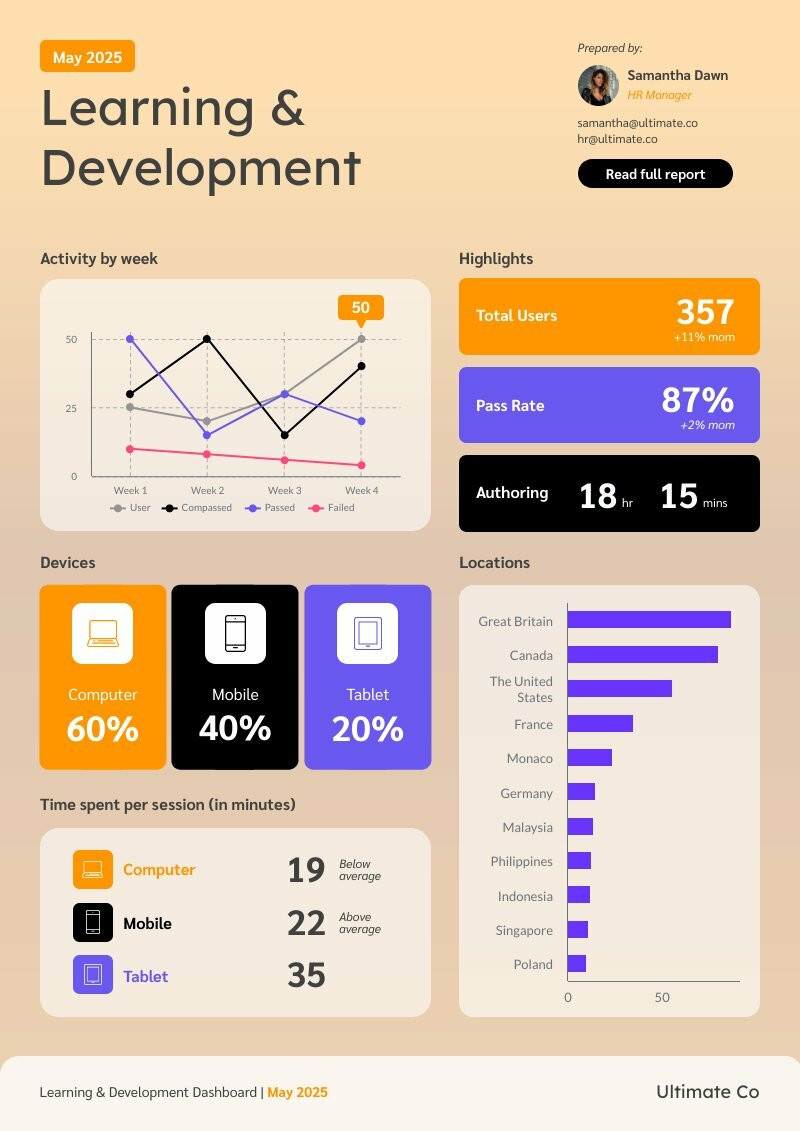
The Indispensable Role of a Structured Learning and Development Report Template
Imagine trying to build a house without a blueprint. It would be chaotic, inefficient, and likely lead to an unstable structure. The same principle applies to demonstrating the value of your L&D programs. Without a clear framework, your efforts to showcase impact can crumble, leaving stakeholders unconvinced and future funding uncertain. A structured learning and development report template serves as that essential blueprint, ensuring every critical piece of information is accounted for and presented cohesively.
It’s not just about ticking boxes; it’s about telling a compelling story with data. A good template prompts you to consider various aspects of your programs, from participant engagement to measurable business outcomes. This systematic approach ensures that your reports are not only comprehensive but also consistent over time, making it easier to track progress, identify trends, and benchmark performance against previous periods or industry standards. It shifts the focus from purely administrative tasks to strategic insight generation.
Furthermore, a well-thought-out template acts as a communication bridge between the L&D department and the rest of the organization. It translates complex learning metrics into easily digestible information that resonates with different audiences, whether it is the HR department, senior leadership, or even individual team managers. This clarity helps in articulating the value of L&D, justifying budgets, and securing buy-in for future initiatives. It fosters a culture of continuous improvement by highlighting what is working well and where adjustments are needed.
Essential Sections Within Your L&D Report
To truly harness the power of your reports, your template should guide you through several key areas. An executive summary, for instance, provides a high-level overview for time-strapped leaders, quickly conveying the most critical findings and recommendations. Following this, sections dedicated to program details can outline the training delivered, the number of participants, and completion rates.
The core of any impactful report lies in its ability to demonstrate outcomes. This means moving beyond simple attendance figures to include qualitative feedback, skill acquisition assessments, and ideally, a link to business key performance indicators. Did the sales team improve their closing rates after product training? Did customer service scores increase post-coaching? These are the questions your report should strive to answer.
A robust template will also incorporate sections for future recommendations and action plans. This forward-looking perspective transforms the report from a mere historical document into a strategic tool, guiding future L&D investments and ensuring alignment with organizational goals. It facilitates a proactive approach to talent development, making L&D a strategic partner rather than just a service provider.
Leveraging Your Reporting for Strategic Growth
Once you have a solid learning and development report template in place and are consistently generating reports, the next step is to truly leverage this information for strategic advantage. These reports are not just administrative requirements; they are powerful tools that can drive organizational growth and foster a culture of continuous learning. By regularly analyzing the data, you can identify patterns, uncover hidden insights, and make data-driven decisions that propel your workforce forward.
Think of your reports as a feedback loop. They show you which programs are yielding the highest return on investment, which areas require more attention, and where there might be skill gaps emerging within your workforce. This intelligence allows you to fine-tune existing training programs, design new ones that are precisely tailored to current needs, and allocate resources more effectively. It transforms L&D from a reactive function into a proactive strategic partner.
Moreover, sharing these insights transparently across the organization can inspire greater engagement with learning initiatives. When employees and managers see the tangible benefits of L&D reported clearly, they are more likely to invest their time and energy into development opportunities. This creates a virtuous cycle where effective reporting leads to more impactful learning, which in turn fuels better business outcomes and a more competitive, skilled workforce.
Embracing a systematic approach to L&D reporting is more than just good practice; it is a fundamental aspect of modern talent management. By consistently tracking, analyzing, and communicating the value of your learning programs, you ensure that your investments in human capital are both wise and effective. This commitment to demonstrating impact ultimately strengthens your organization’s foundation, paving the way for sustained success and innovation in an ever-evolving market landscape.