Ever found yourself in a situation where you need to show your interest in a project, partnership, or opportunity without committing to a full-blown proposal just yet? That’s precisely where an expression of interest proposal template becomes your best friend. It’s a crucial first step, a formal yet concise way to introduce yourself, your capabilities, and your initial ideas, signaling that you’re a serious contender worthy of further consideration. Think of it as your professional handshake, setting the stage for what could be a significant collaboration or project.
This initial document serves a vital purpose: it allows the inviting party to gauge the level of interest and assess potential candidates or partners before investing time and resources into reviewing detailed, lengthy proposals. For you, it’s an opportunity to present your most compelling attributes and vision in a focused manner, demonstrating your alignment with the opportunity’s objectives. It’s about making a strong first impression that opens the door to the next stage of engagement.
In the fast-paced world of business and project development, efficiency is key. A well-structured expression of interest document streamlines this preliminary phase, saving time for both submitters and reviewers. This article will guide you through understanding the core components of an effective template, ensuring your submission stands out and accurately reflects your potential.
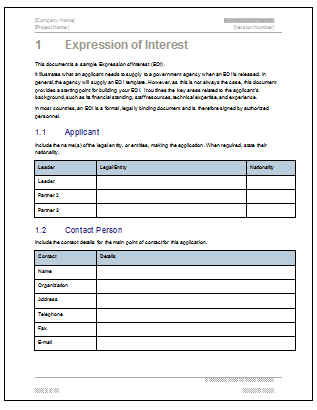
The Purpose of an Expression of Interest and Why a Template is Indispensable
An Expression of Interest EOI is essentially a preliminary document used to solicit interest from potential bidders, suppliers, or partners. It’s not a full proposal, nor is it a binding contract. Instead, it’s a way for an organization to gather information about potential candidates who might be suitable for a specific project, service, or partnership before issuing a more detailed Request for Proposal RFP or tender. It helps filter out unsuitable applicants early in the process, ensuring that only the most relevant and capable parties are invited to submit comprehensive proposals.
For those responding, an EOI is an opportunity to showcase their relevant experience, expertise, and understanding of the opportunity. It allows them to make a strong initial case for why they are a good fit without having to invest the considerable time and resources typically required for a full proposal. This makes the EOI process a win-win, optimizing efficiency for all involved parties.
The benefits of using an EOI are manifold. It allows the inviting party to cast a wide net, attracting diverse talent and innovative ideas, while simultaneously narrowing down the field. For the submitter, it minimizes the effort required at the initial stage, allowing them to focus their detailed proposal efforts only on opportunities where they have a high chance of success. This strategic approach conserves valuable resources like time and money.
Given its critical role, having a robust expression of interest proposal template is not just helpful but essential. A template provides a consistent framework, ensuring that all necessary information is included, presented professionally, and adheres to a logical structure. It acts as a checklist, preventing crucial details from being overlooked and helping you maintain a high standard across all your submissions.
Without a template, you risk inconsistencies in your submissions, which can diminish your professional image and even lead to disqualification if key requirements are missed. A good template ensures that every time you respond to an EOI, your submission is comprehensive, clear, and compelling, reflecting positively on your organization’s attention to detail and professionalism.
A well-designed template also significantly speeds up the drafting process. Instead of starting from scratch each time, you have a pre-defined structure to populate with opportunity-specific details. This not only saves time but also reduces stress, allowing you to focus on tailoring your message and highlighting your unique value proposition for each specific opportunity.
Common Scenarios for Using an EOI
EOIs are frequently used in various sectors. Government agencies often use them for public works projects or research grants. Non-profits might solicit EOIs for community initiatives or funding partnerships. Private companies use them for large procurement contracts, joint ventures, or strategic alliances. Even in academic settings, EOIs can precede calls for research collaborations or student projects. In each case, the goal remains the same: to efficiently identify and pre-qualify interested parties.
Crafting Your Expression of Interest: Practical Tips and Key Components
When putting together your expression of interest, clarity and conciseness are paramount. The reviewers likely have many submissions to go through, so making yours easy to understand and highlighting your key strengths quickly is vital. Focus on communicating your understanding of the opportunity, your relevant experience, and what makes your organization or team uniquely qualified to meet the requirements. Think about how you can stand out while remaining professional and to the point.
A strong EOI typically includes several key sections, each serving a specific purpose. While the exact requirements may vary based on the soliciting party, a comprehensive expression of interest proposal template generally covers the following elements.
- **Introduction and Cover Letter:** Briefly state your purpose for submitting the EOI, identifying the opportunity you are responding to, and expressing your enthusiastic interest. This sets a professional tone.
- **Organization Background and Capabilities:** Provide a concise overview of your organization, its mission, and relevant experience. Highlight past projects or achievements that demonstrate your capacity and expertise related to the opportunity.
- **Understanding of the Opportunity:** Show that you have thoroughly read and understood the requirements and objectives of the project or partnership. Briefly articulate your interpretation of the challenge or goal.
- **Proposed Approach (Brief):** Outline your preliminary ideas or a high-level approach to addressing the opportunity. This is not a detailed plan but rather a demonstration of your strategic thinking and how you might tackle the task.
- **Relevant Team and Resources:** Briefly introduce key personnel who would be involved and mention any unique resources or assets you would bring to the table.
- **Referees and Credentials (Optional):** Include references or attach relevant certifications if explicitly requested or if they significantly bolster your case.
- **Call to Action and Next Steps:** Reiterate your interest and express your eagerness to provide further information or participate in the next stage of the process.
Beyond these structural components, ensuring your EOI is free of grammatical errors and typos is crucial. A polished document reflects professionalism and attention to detail. Tailoring each EOI to the specific opportunity, even when using a template, demonstrates that you have put thought into your submission rather than sending a generic response. Highlighting aspects of your experience that directly align with the stated needs of the inviting party will always make a stronger impression.
Navigating the initial stages of project acquisition or partnership development can be significantly streamlined with the right tools. A carefully prepared expression of interest, built upon a robust template, not only makes the process more efficient for both parties but also positions your submission for success. It acts as your advocate, articulating your value and suitability in a clear, compelling manner, thereby increasing your chances of progressing to the next crucial stage.
By embracing the power of a well-structured EOI, you equip yourself with a powerful instrument for opening doors to new possibilities. It allows you to present your best foot forward, demonstrating your professionalism and strategic thinking from the very outset. Utilizing these principles will undoubtedly enhance your ability to secure future opportunities and foster meaningful collaborations.