In today’s fast-evolving work landscape, the desire for greater autonomy over one’s professional life is more prominent than ever. Many of us dream of a work arrangement that better balances personal commitments with career aspirations, but the thought of formally requesting it can feel daunting. This is where a well-structured **flexible work schedule proposal template** becomes your secret weapon, transforming a daunting request into a clear, professional, and compelling case.
Flexible work isn’t just a perk; it’s a strategic move that can significantly benefit both employees and organizations. For individuals, it can lead to improved well-being, reduced commute stress, and better focus during peak productivity times. For companies, embracing flexibility often translates to higher employee retention, increased job satisfaction, enhanced recruitment appeal, and even a boost in overall productivity and morale.
Successfully advocating for a flexible work arrangement requires more than just asking. It demands thoughtful preparation, a clear understanding of your value, and a well-articulated plan that demonstrates how your proposed schedule will benefit your team and the business. This article will guide you through the process, helping you construct a proposal that resonates and opens the door to a more balanced and productive work life.
Crafting Your Perfect Flexible Work Proposal
When you’re ready to present your case for a flexible schedule, remember that clarity, confidence, and a focus on mutual benefit are your greatest assets. Your proposal isn’t just about what you want; it’s about showing how your desired schedule can contribute positively to your team and the organization. It’s an opportunity to demonstrate your professionalism and commitment.
Understanding Your Company’s Culture and Policies
Before you even begin writing, take the time to research. Does your company have existing flexible work policies? Is there an HR department you can consult? Understanding the current landscape will help you tailor your proposal to fit within established guidelines or, if none exist, provide a solid framework for a new approach. Knowing your company’s stance can help you anticipate potential objections and address them proactively.
Consider your team’s dynamics and your manager’s communication style. Is your workplace generally open to new ideas, or do they prefer highly detailed, data-driven requests? Aligning your proposal’s tone and depth with your company’s culture can significantly improve its reception.
Clearly Defining Your Proposed Schedule
Specificity is key. Don’t just ask for “flexibility.” Clearly outline the exact schedule you’re proposing. Will you work four ten-hour days instead of five eights? Are you requesting to start an hour earlier and finish an hour earlier each day? Will you work remotely two days a week? Provide precise details about your proposed work hours, days, and location. This allows your manager to visualize the change and understand its implications.
Along with the specifics, offer a compelling rationale. Explain *why* this particular schedule would be effective for you and how it might enhance your productivity or ability to meet deadlines. Perhaps you can avoid peak commute times, allowing you to arrive more energized, or perhaps dedicated focus time outside of traditional office hours will enable you to complete complex tasks more efficiently.
Highlighting the Benefits for the Business
This is perhaps the most critical part of your proposal. While your personal well-being is important, your manager needs to see the business case. Focus on how your flexible schedule will benefit the company, your team, and your manager. Will it improve your productivity? Reduce stress and burnout, leading to better long-term performance? Enhance your ability to meet client demands or cover different time zones?
Quantify benefits where possible. For instance, “By shifting my hours, I can be available to support our West Coast clients for an additional two hours each day,” or “This schedule will allow me to dedicate uninterrupted time to complex projects, potentially reducing project completion times by X%.” Emphasize how your proposal aligns with company goals like employee retention, talent attraction, or improved service delivery.
Addressing Potential Concerns and Solutions
Proactively anticipate any concerns your manager might have and offer solutions. Will there be gaps in coverage? How will you maintain communication with your team? How will you handle urgent requests? Outline strategies like cross-training colleagues, setting up clear communication protocols (e.g., specific availability hours, instant messaging during work hours), or establishing a system for urgent task handovers.
Suggest a trial period. Proposing a 3-month trial period demonstrates your commitment and allows both you and your manager to assess the effectiveness of the new arrangement. This reduces the perceived risk for your employer, making them more likely to agree to the experiment. During the trial, you can collect data to support its continuation.
Key Elements of an Effective Template
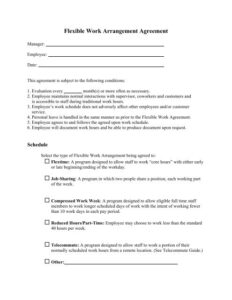
A comprehensive flexible work schedule proposal template organizes your thoughts and ensures you present a professional, well-considered request. It acts as a framework, guiding you through all the essential points your manager will need to evaluate. By using a template, you won’t overlook critical details that could strengthen your case.
Here are the fundamental components every strong proposal should include:
- Employee Information: Your name, title, department, and contact information.
- Date of Proposal: For clear record-keeping.
- Proposed Schedule: Clear details of your desired work hours, days, and location.
- Rationale/Justification: Why this schedule works for you and how it enhances your productivity or focus.
- Benefits to the Company/Team: Highlight tangible advantages like improved output, retention, coverage, or morale.
- Addressing Potential Concerns: Proactive solutions for communication, coverage, or potential workflow disruptions.
- Communication Plan: How you will stay connected with your team and manager.
- Trial Period Suggestion: A proposed duration for evaluating the new arrangement.
- Metrics for Success: How the effectiveness of the new schedule will be measured.
- Next Steps: A request for a meeting to discuss the proposal further.
Each section of the template serves a specific purpose, building a logical and persuasive argument. It allows you to present a holistic view, showing that you’ve thought through the implications of your request not just for yourself, but for the entire team and the business as a whole. Remember, while a template provides structure, the content within it needs to be uniquely tailored to your role, your team, and your company’s specific needs.
Personalizing your proposal, even when starting with a flexible work schedule proposal template, is crucial. It shows genuine commitment and a deep understanding of your job responsibilities. Customizing the details ensures that your request feels authentic and directly relevant to your unique professional situation, making it far more likely to be met with consideration.
Embracing a flexible work arrangement can unlock new levels of productivity and job satisfaction, allowing you to integrate your professional and personal lives more harmoniously. Presenting a well-researched, thoughtful proposal demonstrates your commitment not only to your own well-being but also to the continued success of your team and organization. It’s a proactive step towards building a work environment that values results and employee empowerment.
Take the leap and articulate your vision for a more adaptable work life. With a strong proposal in hand, you’re not just asking for a change; you’re presenting a valuable opportunity for everyone involved. Your initiative can pave the way for a more balanced, productive, and fulfilling professional journey.