Ensuring the safety of a building’s occupants and assets is paramount, and a robust fire suppression system plays a critical role in achieving this goal. Among these systems, fire sprinklers are undeniably effective, but their reliability hinges on regular, thorough inspections and meticulous record-keeping. This is where a well-designed fire sprinkler inspection report template becomes an indispensable tool for facility managers, safety officers, and fire protection professionals.
Regular maintenance and documented inspections are not just good practice; they are often legal requirements. Without a standardized approach, vital checks can be missed, leading to potential system failures when they are needed most. A comprehensive template provides a structured framework, ensuring every critical component of a fire sprinkler system is evaluated consistently and accurately.
This article will delve into why a dedicated fire sprinkler inspection report template is essential for compliance and safety. We’ll explore the key elements such every effective template should contain, helping you understand how to streamline your inspection process. Finally, we’ll provide a clear example of what such a template might look like, empowering you to enhance your fire safety protocols.
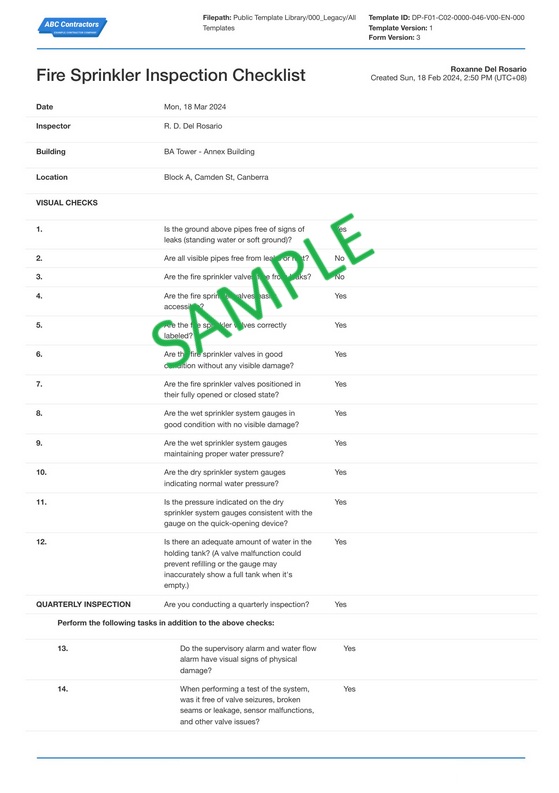
Why a Standardized Fire Sprinkler Inspection Report Template is Essential
Maintaining fire sprinkler systems goes far beyond a casual glance. It requires a systematic approach to identify potential issues before they escalate into dangerous failures. A standardized fire sprinkler inspection report template is crucial for achieving this level of diligence and helps to ensure that critical safety measures are never overlooked. It acts as a guide, a checklist, and a detailed record all in one.
Such a template is a foundational element for any effective fire safety program. It simplifies complex compliance requirements and provides undeniable proof of due diligence. By adopting a consistent format, organizations can significantly improve their overall safety posture and operational efficiency.
Ensuring Regulatory Compliance and Safety Standards
Fire safety regulations, like those outlined in NFPA 25 (Standard for the Inspection, Testing, and Maintenance of Water-Based Fire Protection Systems), are complex and detailed. Adhering to these standards is not just about avoiding penalties; it’s about safeguarding lives and property. A robust inspection report template ensures that every check mandated by these codes is performed and documented.
Proper documentation from a reliable fire sprinkler inspection report template serves as critical evidence during audits or investigations. It demonstrates that the building owner or manager is actively meeting their legal obligations. This proactive approach significantly reduces liability in the unfortunate event of a fire incident. Compliance ultimately translates directly into enhanced safety for everyone within the premises.
Streamlining Maintenance and Identifying Issues Early
Consistency is key in preventive maintenance. A standardized template ensures that every inspection, regardless of who conducts it, follows the same rigorous procedure. This eliminates guesswork and helps identify trends in system performance or recurring issues. Early detection of problems, such as minor leaks, corroded pipes, or faulty valves, can prevent catastrophic failures.
By documenting findings systematically, a template allows for better tracking of the system’s health over time. Technicians can easily refer to previous reports to understand the system’s history and prioritize necessary repairs. This streamlined process not only saves time and resources but also extends the operational lifespan of the fire sprinkler system.
Facilitating Clear Communication and Record-Keeping
An organized fire sprinkler inspection report template acts as a central repository for all critical information. It provides a clear, unambiguous record of the system’s status, deficiencies found, and corrective actions taken. This clarity is invaluable for communication among maintenance teams, facility management, and external regulatory bodies.
Effective record-keeping is vital for demonstrating accountability and transparency. Should there be a change in personnel or a need to review past inspections, all the necessary data is readily accessible and understandable. This continuity in documentation supports ongoing maintenance efforts and helps maintain a consistent level of safety oversight for the property.
Key Elements of an Effective Fire Sprinkler Inspection Report Template
Crafting an effective fire sprinkler inspection report template requires careful consideration of all relevant components and regulatory requirements. A truly comprehensive template will guide inspectors through every necessary check, leaving no room for oversight. It moves beyond a simple checklist to become a detailed record of the system’s health and performance.
The best templates are designed to be intuitive for the inspector yet thorough enough to satisfy compliance demands. They balance ease of use with the need for detailed technical data. Understanding these core components is the first step in creating or selecting a template that truly serves its purpose.
System Identification and General Information
Every inspection report should begin with a section dedicated to identifying the property and the specific fire sprinkler system being evaluated. This essential information provides context for the entire report. Accuracy in these details is crucial for proper record-keeping and future reference.
Key fields in this section typically include:
- Facility Name and Address
- Inspection Date and Time
- Inspector’s Name and Company
- Contact Information for Facility Representative
- Type of Sprinkler System (e.g., Wet, Dry, Pre-action, Deluge)
- System Location within the Building (e.g., Building A, Floor 3)
- Last Inspection Date
Detailed Inspection Checklists
The heart of any fire sprinkler inspection report template lies in its detailed checklists. These sections guide the inspector through a systematic evaluation of every critical component of the sprinkler system. Each item should have a clear “Pass,” “Fail,” or “N/A” option, along with space for specific comments or observations.
Here’s a breakdown of common checklist categories:
- Water Supply Components:
- Main control valves (open/closed, supervised)
- Pressure gauges (readings within normal range)
- Water flow switches (tested, operational)
- Backflow preventers (inspected, tested)
- Fire department connections (accessible, caps in place)
- Piping and Sprinkler Heads:
- Piping (free from leaks, corrosion, damage)
- Hangers and supports (secure, adequate)
- Sprinkler heads (correct type, free from obstruction, no damage, no paint)
- Spare sprinkler heads (on site, wrench available)
- Valves:
- All valves (accessible, properly tagged, seals intact)
- Tamper switches (functional)
- Drain valves (tested for proper flow)
- Fire Pump (if applicable):
- Pump components (inspected for leaks, vibration)
- Controllers (operational, proper settings)
- Engine/Motor (fuel levels, oil, battery condition)
- Test header and gauges (functional)
- Alarms and Signaling Devices:
- Water motor gongs (operational)
- Electric bells/horns (operational)
- Control panel indicators (normal status)
- Anti-freeze Loops (if applicable):
- Solution levels and concentration
- Condition of piping
Deficiencies, Corrective Actions, and Recommendations
This critical section is where any issues discovered during the inspection are documented. It provides a clear record of problems and outlines the steps needed to rectify them. A good fire sprinkler inspection report template will separate identified deficiencies from the proposed solutions.
This part of the report should include:
- Deficiency Description: A clear, concise explanation of the problem found.
- Severity Level: Categorization of the deficiency (e.g., Critical, Minor, Observation).
- Location: Specific area where the deficiency was found.
- Recommended Corrective Action: Detailed steps to resolve the issue.
- Date Corrected/Follow-up Date: For tracking resolution.
- Inspector’s Recommendations: Any general advice for improving system performance or maintenance practices.
- Signatures: Spaces for the inspector and facility representative to sign off, acknowledging the report and any noted deficiencies.
Sample Fire Sprinkler Inspection Report Template Format
Below is an example of the structured format for a comprehensive fire sprinkler inspection report template. This outlines the typical sections and types of information captured, providing a clear visual representation of how data is organized within such a document. This format is designed for clarity, completeness, and ease of use, making it an invaluable tool for any inspection process.
FIRE SPRINKLER SYSTEM INSPECTION REPORT

**I. General Information**
    *   **Facility Name:** _________________________
    *   **Facility Address:** ___________________________________
    *   **Inspection Date:** ____/____/________
    *   **Inspection Time:** ______:______ AM/PM
    *   **Inspector Name:** _________________________
    *   **Inspector Company:** _________________________
    *   **System Type:** [ ] Wet [ ] Dry [ ] Pre-action [ ] Deluge [ ] Other: ______
    *   **System Location:** _________________________
    *   **Last Inspection Date:** ____/____/________

**II. Water Supply Inspection**
    *   **Main Control Valve (MCV):**
        *   Open and fully supervised: [ ] Yes [ ] No
        *   Seals/Locks intact: [ ] Yes [ ] No
        *   Reading (psi): ________
    *   **System Pressure Gauge:**
        *   Reading (psi): ________
        *   Condition: [ ] Good [ ] Needs Calibration [ ] Damaged
    *   **Water Flow Alarm:**
        *   Test Activated: [ ] Yes [ ] No
        *   Alarm Sounded: [ ] Yes [ ] No
    *   **Backflow Preventer:**
        *   Inspected for leaks: [ ] Yes [ ] No
        *   Test Date: ____/____/________ (If applicable)
    *   **Fire Department Connection (FDC):**
        *   Accessible: [ ] Yes [ ] No
        *   Caps/Plugs in place: [ ] Yes [ ] No

**III. Piping and Sprinkler Head Inspection**
    *   **Piping:**
        *   Free from leaks/corrosion: [ ] Yes [ ] No
        *   Damage/Obstructions: [ ] Yes [ ] No (Describe in Deficiencies)
    *   **Hangers and Supports:**
        *   Secure and adequate: [ ] Yes [ ] No
    *   **Sprinkler Heads:**
        *   Free from paint/corrosion/damage: [ ] Yes [ ] No
        *   Proper orientation/coverage: [ ] Yes [ ] No
        *   Correct type for occupancy: [ ] Yes [ ] No
    *   **Spare Sprinkler Heads:**
        *   On-site: [ ] Yes [ ] No
        *   Wrench available: [ ] Yes [ ] No

**IV. Valve Inspection**
    *   **All Control Valves:**
        *   Accessible and properly tagged: [ ] Yes [ ] No
        *   Open/Closed (as required): [ ] Yes [ ] No
    *   **Tamper Switches:**
        *   Functioning correctly: [ ] Yes [ ] No
    *   **Drain Valves:**
        *   Tested for proper flow: [ ] Yes [ ] No

**V. Fire Pump Inspection (If Applicable)**
    *   **Pump Operation:** [ ] Automatic [ ] Manual
    *   **Visual Check (Leaks, Vibration):** [ ] Good [ ] Needs attention
    *   **Controller Indicators:** [ ] Normal [ ] Abnormal
    *   **Engine/Motor Condition (Fuel, Oil, Battery):** [ ] Good [ ] Needs attention

**VI. Deficiencies and Recommendations**
| Item # | Location | Description of Deficiency | Severity (Critical/Minor/Observation) | Recommended Corrective Action | Date Corrected |
|--------|----------|---------------------------|---------------------------------------|-------------------------------|----------------|
| 1.     |          |                           |                                       |                               |                |
| 2.     |          |                           |                                       |                               |                |
| 3.     |          |                           |                                       |                               |                |

**VII. Inspector & Facility Representative Signatures**
    *   **Inspector Signature:** _________________________ Date: ____/____/________
    *   **Facility Representative Signature:** _________________________ Date: ____/____/________
This sample outlines the basic structure. Real-world templates often include more detailed sub-sections, specific checkboxes for different types of sprinkler heads, or additional space for photos and extensive notes. The key is to cover all required elements efficiently while maintaining clarity. This structured approach helps ensure no critical component is overlooked during the inspection of the fire suppression system.
The use of a clear, standardized format helps ensure that all necessary information is captured consistently across inspections. It simplifies the process for the inspector and provides an easily understandable record for facility management. This organized structure for a fire sprinkler inspection report template is paramount for maintaining system reliability.
A well-executed fire sprinkler inspection report template is more than just a piece of paper; it’s a vital component of any robust fire safety strategy. It provides the necessary structure to ensure compliance, identify potential problems early, and maintain detailed records. By adopting such a template, you empower your team to conduct thorough inspections that actively contribute to the safety and longevity of your fire suppression systems.
Investing in a comprehensive and easy-to-use template ultimately protects your property, your occupants, and your peace of mind. Regular, documented inspections are a non-negotiable aspect of responsible building management. Make sure your fire sprinkler inspection report template is up to the task of upholding the highest standards of safety and operational efficiency.