When disaster strikes, or a critical incident unfolds, the immediate focus is on response and recovery. However, the most profound lessons are often learned in the calm that follows. Understanding what happened, why it happened, and how the response performed is crucial for future preparedness. This is where an effective emergency management after action report template becomes an invaluable tool for any organization or community.
An After Action Report (AAR) provides a structured analysis of an incident, allowing emergency managers to document the events, assess performance, and identify areas for improvement. Utilizing a standardized emergency management after action report template ensures consistency, thoroughness, and facilitates a clear understanding of successes and challenges. It transforms raw incident data into actionable intelligence, enhancing resilience and readiness for the next crisis.
This comprehensive guide will explore the critical role of AARs, detail the key components of a robust template, and provide a sample structure to help you create or refine your own. You’ll learn how to leverage this vital document to continuously improve your emergency management capabilities and protect your assets and personnel more effectively.
Understanding the Vital Role of After Action Reports in Emergency Preparedness
After Action Reports are more than just paperwork; they are a cornerstone of continuous improvement in emergency management. They provide a systematic way to debrief incidents, exercises, or events, capturing the institutional knowledge gained from real-world experiences or simulated scenarios. Without a structured review process, valuable insights can be lost, and the same mistakes might be repeated in future operations.
Organizations committed to effective crisis response understand that learning is an ongoing process. An After Action Report facilitates this learning by providing a detailed record of events, decisions made, and their outcomes. This documentation is essential for training new personnel, refining standard operating procedures, and securing necessary resources.
Identifying Strengths and Areas for Improvement
One of the primary benefits of using an After Action Report is its ability to objectively highlight what worked well and what did not. During the chaos of an emergency, responders often operate on instinct and training. An AAR allows for a calm, post-event analysis to pinpoint specific actions that were successful. These strengths can then be integrated into future planning and training programs.
Conversely, the report also uncovers weaknesses or gaps in planning, resources, or communication. Perhaps a specific piece of equipment failed, or a communication channel proved inadequate under stress. Identifying these “hot spots” is the first step toward correcting them, ensuring that future responses are more efficient and effective.
Fostering Continuous Improvement and Organizational Resilience
The core purpose of any After Action Report is to drive continuous improvement. By documenting lessons learned, organizations can adapt their strategies, update their emergency plans, and provide targeted training. This iterative process builds greater organizational resilience, making the entity more capable of withstanding and recovering from future incidents.
Regularly conducting After Action Reviews and updating plans based on their findings creates a culture of preparedness. It encourages personnel at all levels to contribute their observations and insights, fostering a collective commitment to enhancing safety and response capabilities. This proactive approach is far more effective than simply reacting to emergencies as they occur.
Ensuring Accountability and Compliance Standards
An After Action Report also plays a crucial role in ensuring accountability and meeting regulatory compliance. Many industries and government agencies have specific requirements for documenting incident responses and corrective actions. A well-prepared AAR serves as official documentation of an organization’s efforts.
It provides a transparent record of decisions made, resources deployed, and the rationale behind actions taken. This is particularly important for demonstrating due diligence, especially in scenarios that might involve legal scrutiny or public inquiry. The report helps ensure that protocols were followed and that any deviations are noted with corrective measures.
Key Elements of an Effective Emergency Management After Action Report Template
A robust emergency management after action report template is structured to capture all critical information in a logical and easily digestible format. While specific details may vary depending on the incident’s nature and the organization’s requirements, several core elements are universally essential. These sections ensure that the review process is thorough and yields actionable insights.
A well-designed template guides the reviewer through each phase of the incident, from initial notification to recovery efforts. It prompts for specific data points, observations, and recommendations, preventing important details from being overlooked. This standardization is key to comparing performance across multiple incidents or exercises.
Executive Summary and Incident Overview
The Executive Summary provides a high-level synopsis of the entire incident and the review’s key findings. It should be concise and present the most critical takeaways, allowing busy stakeholders to quickly grasp the essence of the report without delving into every detail. This section often includes the incident name, date, location, and a brief description of the event.
The Incident Overview then expands on this by providing more context. It includes a timeline of significant events, details about the incident’s scope and impact, and the objectives of the emergency response. This section sets the stage for the detailed analysis that follows, ensuring all readers have a foundational understanding of the situation being reviewed.
Detailed Analysis of Operations and Performance
This is the core analytical section of the AAR. It systematically examines how various operational functions performed during the incident. This detailed review often breaks down performance by specific areas, such as communications, logistics, command and control, public information, and resource management. Data points, observations, and objective assessments are crucial here.
For each operational area, the report should identify specific strengths and weaknesses. It asks critical questions: Were communication channels effective? Was equipment functioning as expected? Were personnel adequately trained and equipped? Evidence, such as communication logs, resource tracking data, and participant interviews, should support all observations.
Actionable Recommendations and Lessons Learned
The true value of an After Action Report lies in its ability to generate actionable recommendations. This section translates the observations and analysis into concrete steps for improvement. Each recommendation should be specific, measurable, achievable, relevant, and time-bound (SMART).
Lessons learned are broader insights gained from the incident that can be applied to future planning and training across the organization. They often describe changes needed in policies, procedures, equipment, or training methodologies. This section is often presented as a bulleted list to make it easy to identify and track.
- Review of current emergency plans and procedures
- Enhancement of communication protocols during crises
- Identification of specific training gaps for personnel
- Assessment of resource availability and allocation
- Improvements in inter-agency coordination strategies
- Evaluation of public information dissemination methods
Sample Emergency Management After Action Report Template Structure
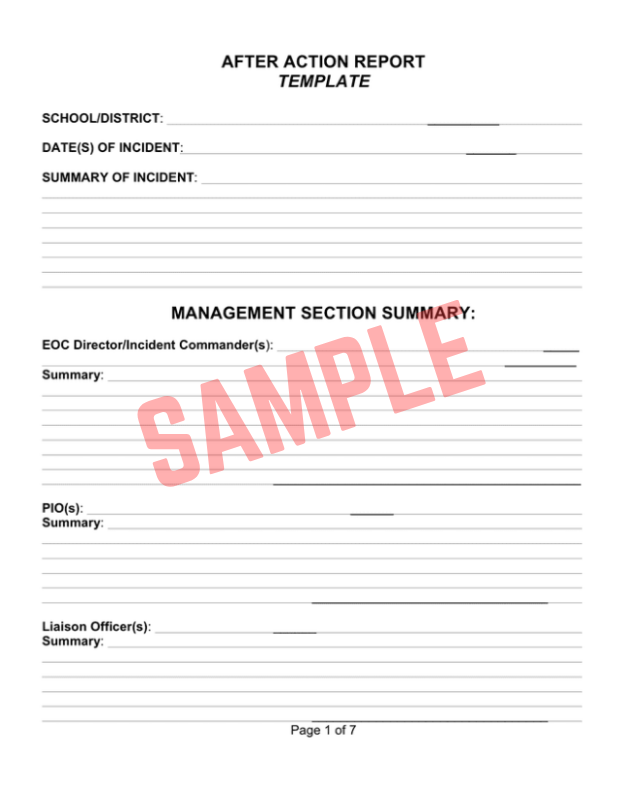
A well-structured emergency management after action report template guides the creation of a comprehensive and useful document. This sample outline provides a robust framework that can be adapted to various types of incidents and organizational needs. Each section prompts for specific information crucial for a thorough review and effective planning.
This structure is designed to facilitate easy completion and clear readability, ensuring that the insights gained from the incident are effectively communicated to all relevant stakeholders.
Report Title: [Incident Name] After Action Report
Date of Report: [Date of completion]
Reporting Period: [Start Date of Incident] – [End Date of Incident]
Review Conducted By: [Name/Department]
Section 1: Executive Summary
- Brief overview of the incident, including type, location, and dates.
- Summary of key findings (2-3 major strengths and areas for improvement).
- Overview of the most critical recommendations.
Section 2: Incident Overview
Incident Description
- Detailed narrative of the incident’s progression.
- Initial trigger event and subsequent developments.
Response Objectives
- What were the stated goals of the emergency response?
- How were these objectives communicated and measured?
Resources Utilized
- Personnel involved (internal, external agencies).
- Equipment and facilities deployed.
- Financial resources expended.
Timeline of Key Events
- Chronological list of significant actions, decisions, and outcomes.
- Example: “09:00 – Incident reported; 09:15 – Incident Command established; 10:30 – Evacuation commenced.”
Section 3: Analysis of Operations
Command and Control
- Effectiveness of leadership and decision-making structure.
- Clarity of roles and responsibilities.
Communications
- Internal communication effectiveness (between responders, departments).
- External communication effectiveness (with public, media, stakeholders).
- Reliability and interoperability of communication systems.
Logistics and Resource Management
- Timeliness and adequacy of resource deployment.
- Effectiveness of supply chain and distribution.
- Management of personnel welfare and support.
Public Information and Warning
- Accuracy and timeliness of public alerts and instructions.
- Effectiveness of public outreach channels.
Safety and Security
- Measures taken to ensure responder and public safety.
- Identification of any safety breaches or concerns.
Section 4: Strengths and Best Practices
- Specific examples of successful actions or processes.
- Identification of innovative solutions or exemplary performance.
Section 5: Areas for Improvement and Challenges
- Specific challenges encountered (e.g., equipment failure, communication breakdown).
- Areas where performance did not meet expectations or plans.
Section 6: Recommendations and Lessons Learned
Recommendations
- Specific, actionable steps to address identified weaknesses.
- Each recommendation should include an assigned lead and a target completion date.
- Example: “Update shelter registration process; Lead: Emergency Coordinator; Due: MM/DD/YYYY.”
Lessons Learned
- Generalizable insights that can inform future planning and training.
- Broader implications for policy, procedure, or resource allocation.
Section 7: Appendix (Optional)
- Supporting documentation (e.g., photos, communication logs, maps, contact lists).
- Lists of participants, interview notes, survey results.
Implementing a structured After Action Report template, like the one outlined above, provides a clear pathway to organizational learning and growth. It transforms critical incidents from mere events into powerful learning opportunities. By consistently applying this framework, your organization can continually refine its emergency response capabilities, building a more resilient and prepared future.
The diligent use of an emergency management after action report template is not just a best practice; it is a fundamental requirement for anyone serious about effective emergency management. It provides the structured reflection necessary to convert raw experience into actionable wisdom. Start leveraging the power of thorough incident review today to bolster your preparedness.