In the world of scientific discovery, communicating findings clearly and accurately is just as crucial as the research itself. Whether you’re a high school student conducting your first experiment or a university researcher delving into complex data, a well-structured report is the backbone of effective scientific discourse. Mastering the art of scientific reporting begins with understanding and utilizing a robust formal science lab report template. This guide will walk you through the essential components, ensuring your work is presented professionally, clearly, and ready for critical review.
A meticulously prepared lab report not only documents your experiment but also demonstrates your understanding of scientific principles, methodologies, and data analysis. It allows others to replicate your work, verify your findings, and build upon your research. Adopting a standardized approach with a formal science lab report template saves time, reduces errors, and enhances the overall readability and credibility of your scientific contributions. By the end of this article, you’ll have a clear roadmap to crafting compelling and academically sound lab reports.
Essential Elements of a High-Quality Science Lab Report
A successful science lab report is more than just a summary of an experiment; it’s a narrative that guides the reader through the scientific process, from initial hypothesis to final conclusion. Each section serves a distinct purpose, building logically upon the last to create a comprehensive and cohesive document. Adhering to a standardized format ensures that all critical information is presented in an easily digestible manner, facilitating understanding and review.
Title and Abstract: The First Impression
The title is the gateway to your report, offering a concise summary of your experiment’s focus. It should be informative, specific, and engaging, hinting at the core subject matter without revealing all the details. A well-crafted title immediately signals the report’s relevance to the reader.
Following the title, the abstract provides a brief, standalone summary of the entire report. It typically includes the purpose of the experiment, the methods used, the key results obtained, and the main conclusions drawn. Aim for brevity and clarity, usually keeping it under 250 words, allowing readers to quickly grasp the essence of your research.
Introduction: Setting the Stage
The introduction sets the context for your experiment, providing necessary background information and theoretical framework. It should explain why the experiment was conducted, referencing relevant prior research or scientific principles. This section aims to educate the reader on the foundational knowledge required to understand your study.
Crucially, the introduction also states the purpose of the experiment, outlining the specific questions your research aims to answer. It culminates in a clear and testable hypothesis, which is your educated prediction about the outcome of the experiment. This hypothesis should be framed in a way that can be supported or refuted by your experimental data.
Materials and Methods: Reproducibility is Key
This section details the specific materials, equipment, and procedures used to conduct your experiment. The goal is to provide enough information so that another researcher could precisely replicate your study, ensuring the reproducibility and validity of your findings. Be precise with measurements, types of equipment, and experimental conditions.
Describe your experimental design step-by-step in chronological order, using clear and concise language. Include details about variables, controls, and any specific techniques employed. Diagrams or flowcharts can often enhance clarity in this section, illustrating complex setups or processes more effectively.
Analyzing and Presenting Your Findings Effectively
After meticulously conducting your experiment, the next crucial step is to analyze and present your data in a way that is clear, objective, and insightful. This involves not only showcasing your raw results but also interpreting their significance and discussing potential implications. A strong analytical section transforms raw data into meaningful scientific understanding.
Results: What Did You Observe?
The results section presents your findings without interpretation or discussion. It’s where you objectively report the data collected during your experiment. This data should be organized logically, often utilizing tables, graphs, and figures to display trends, patterns, and numerical outcomes. Ensure all figures and tables are properly labeled, titled, and referenced within the text.
Describe significant observations, measurements, and calculations in a narrative format, highlighting key trends or anomalies. Do not explain why something happened in this section; simply state what happened. Visual aids are particularly effective for conveying complex data sets efficiently.
Discussion: Interpreting the Data
The discussion is where you interpret your results in relation to your hypothesis and the background information presented in the introduction. Begin by stating whether your results supported or refuted your hypothesis, and then provide evidence from your data to justify your conclusion. Explain the underlying scientific principles that might account for your observations.
Consider any potential sources of error or limitations in your experimental design that could have influenced the results. This critical self-assessment demonstrates a thorough understanding of the scientific process. You should also compare your findings to existing literature or expected outcomes, discussing any discrepancies and their possible reasons.
Conclusion and References: Summing It Up
The conclusion briefly summarizes the main findings of your experiment and reiterates whether your hypothesis was supported or rejected. It should be concise and directly address the purpose stated in your introduction. Discuss the broader implications of your results and suggest areas for future research or further experimentation.
Finally, the references section lists all sources cited within your report, ensuring proper attribution and academic integrity. Use a consistent citation style (e.g., APA, MLA, Chicago) as specified by your instructor or institution. This section demonstrates the foundation of your research in existing scientific knowledge.
Sample Formal Science Lab Report Template
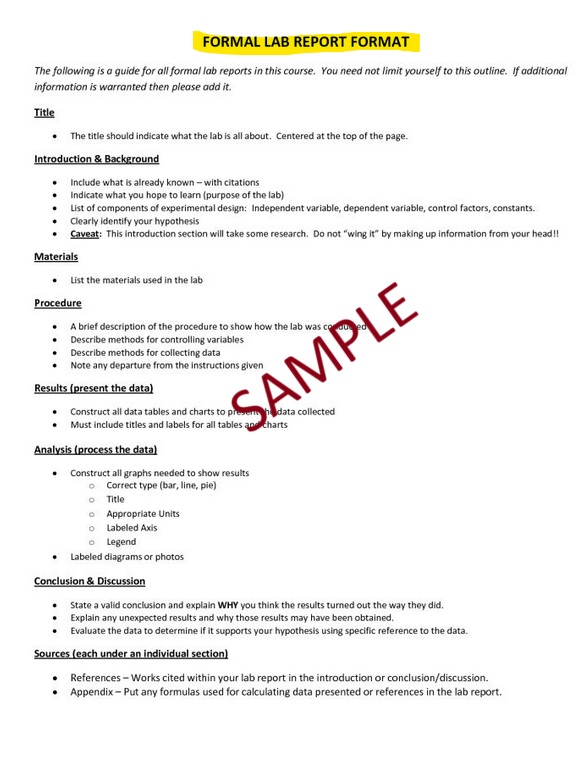
Understanding the theoretical components of a lab report is one thing, but seeing a clear structure can truly solidify your grasp. Here’s a foundational formal science lab report template that you can adapt for various scientific disciplines and experiments. This outline provides a strong framework for presenting your scientific work comprehensively and professionally, acting as your guide for organized reporting.
- Title:
- A concise, informative statement describing the experiment’s main focus.
- Example: “The Effect of Temperature on the Enzyme Activity of Amylase”
- Abstract:
- A brief, comprehensive summary (150-250 words) covering:
- Purpose of the experiment.
- Key methods used.
- Summary of major results.
- Main conclusions drawn.
- A brief, comprehensive summary (150-250 words) covering:
- Introduction:
- Background Information: Provide relevant scientific context, theories, and concepts.
- Purpose: Clearly state the objective of the experiment. What question are you trying to answer?
- Hypothesis: Present a testable prediction about the outcome of the experiment, often in an “If… then… because…” format.
- Materials and Methods:
- Materials: List all equipment, chemicals, and supplies used, including specific quantities, concentrations, and manufacturers where relevant.
- Procedure: Describe the experimental steps in a clear, sequential manner. Use past tense and passive voice (e.g., “Water was added…”) unless instructed otherwise. Include details on experimental setup, control groups, and variable manipulation.
- Data Collection: Explain how data was recorded and measured.
- Results:
- Present all collected data, observations, and calculations objectively.
- Use tables, graphs, and figures (properly labeled and titled) to display data effectively.
- Describe trends and patterns observed in the data in narrative form, without interpretation.
- Discussion:
- Analysis: Interpret the results in relation to your hypothesis. Did the data support or refute it?
- Explanation: Explain why the results occurred, referencing scientific principles.
- Sources of Error: Discuss potential errors or limitations in the experimental design and their possible impact on the results.
- Comparison: Relate your findings to existing scientific literature or expected outcomes.
- Implications: Discuss the significance of your findings.
- Conclusion:
- Summarize the main findings and directly state whether the hypothesis was supported.
- Briefly discuss the broader implications or future research possibilities.
- References:
- List all sources cited in the report using a consistent academic citation style.
Mastering the structure and content of a formal science lab report is a critical skill for anyone engaged in scientific inquiry. By systematically addressing each section, you not only clarify your own understanding of the experiment but also enable others to follow your scientific journey. Utilizing a robust formal science lab report template, like the one outlined above, empowers you to present your research with confidence and clarity, making your contributions impactful.
Embrace the structured approach to lab reporting; it’s an investment in your scientific communication skills. A well-organized report reflects a well-organized mind, and in science, clarity is paramount. So, the next time you embark on an experiment, remember these guidelines to articulate your findings effectively and contribute meaningfully to the scientific community.